India’s first actively managed ETF

1 Comment

Motilal Oswal (MO) one of the larger stockbrokers in India is launching its first structured product the MOSt Shares M50, which is an actively managed exchange traded fund (ETF). ETFs as an investment vehicle are pretty old school in the US where over USD 600 billion are tucked into them.

In India, ETFs are relatively unknown and most of the ETFs have been passive index funds tracking the Sensex or Nifty. Benchmark has been the 800 lb gorilla in the Indian ETF space with their Nifty BeES which tracks the Nifty index. The MOSt Shares M50 is one of the first actively managed ETFs in India. Which means that a fund manager, Rajnish Rastogi, is actively managing the money and can tweak the investment model in real time. According to Rastogi’s LinkedIn profile he “developed the first (worldwide) fundamentally enhanced index and obtained regulatory approval to manage an Exchange Traded Fund (ETF) that tracks it.” If you are looking for more details about the ETF you can visit their site and download the mind numbing PDFs.

For me what is interesting is seeing the ETF space grow in India. ETFs typically have a lower cost (known as expense ratio in the biz) and can be traded via your local stockbroker. When people ask for investing advice, I give them my 3 stage process:

1. Absolute beginner – get an ETF or mutual fund that tracks the index (Benchmark Nifty BeES is an example)
2. Intermediate – broadly invest in ETFs or mutual funds (for example: Reliance Growth Fund or MOSt Shares M50)
3. Expert or gambler – invest directly into the stock market by picking the stocks yourself

I will be tracking the MOSt Shares M50 to see how it outperforms against the Nifty. According to them, they will pick the same stocks in the Nifty 50 index but “remix” the index. Would I recommend this product? Potentially, but I need to see how the ETF stacks up against the index and more importantly does the ETF have enough daily trading liquidity.

For more information on how ETFs got started checkout Wikipedia.

The 1,000 point drop

2 Comments

The thud you heard on Thursday was a 1,000 point drop in the Dow which then recovered 650 of those points in a matter of minutes. So what happened?  Within hours, we got to hear all sorts of excuses such as a Citi trader fat figured a sell order for 1 billion instead of 1 million.  Then the next round of excuses were about “algo black boxes” making a bad situation worse.

If these orders were executed within milliseconds, then how the hell are we still trying to figure out the cause 48 hours later.  I’m sure a lot has todo with ECN’s, which is where about 60% of all trades now take place. ECN’s provide a way for traders to be not so transparent with their trades. If algorithmic trading funds are called black boxes then ECN’s are the mother of all black boxes.

What we have experienced over the past 18 months in the financial markets seems to have a similar thread – transparency. The entire CDO complex was opaque since they were not listed on an exchange and only after it blew up did we start to learn what was happening.

True transparency leads to quicker price discovery and that’s the problem. You can’t make a boat load of money if everyone knows what you are doing. That’s the struggle of Wall Street vs Main Street, Wall Street likes the current structure and Main Street wants to open it up. Since the sub-prime meltdown NOT ONE rule has been passed to regulate the CDO market, however the US Government has bailed out Wall Street to the tune of over $1 Trillion.

I really hope the SEC makes an example of this ridiculous 1,000 point dip and specifically names the client, the broker/dealer and where the trades took place. Let the transparency begin with this government inquiry.

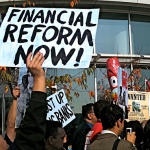
Financial Reforms?

4 Comments

The SEC strikes again as it issues a Wells notice to Goldman Sachs (GS) for selling CDO’s that were allegedly created to fail. A major hedge fund (Paulson & Co.) was on the short side of the trades and apparently he selected what securities would go into the CDO. I’m just calling it “shady shit.”

A couple of points. First, I’m sure other investment banks did the same thing and it’s not just a “Goldman thing.” Second, GS will pay a fine and sweep it under the rug. Coincidently, talk of financial reforms are doing the rounds on Capital Hill, some say the timing of the Wells notice and government financial reforms was coordinated. Might be.

Personally, I think 2 things would make a difference and a lasting impression.  First, instead of targeting specific instruments such as derivatives, a macro view might be a better approach. It would be similar to someone committing a crime with a knife will get XYZ punishment, or if you committed the crime with a gun then its something else.  When really you should be targeting the crime itself.  Since, Wall Street is really driven by money I think that’s where they should start.  Instead of basing a fine on the profit someone made, it should be based on the value of the security. In the Goldman case they should not target the USD 30 million or so that GS made. Instead, they should base the fine on the initial value or ending value of the security (whichever is higher) – USD 1 billion. That changes the dynamics of the risk management team, then everyone is watching everyones back and some dumb ass VP won’t be misrepresenting a USD 1 billion transaction.

Secondly, the Glass-Steagall Act has to come back.  It originally stated that commercial banks and investment banks were seperate.  In 1999 that act was repealed and the effects of that are pretty obvious – it was like putting Wall Street on a cocaine, alcohol and steroid fueled binge. In addition, they should take it a step further, you cannot trade on behalf of the company (aka prop books). Prop books would have to be spun-off and their P&L managed individually. If anybody thinks that front running does not occur is fooling themselves. Talk of a Chinese Wall is pure garbage, it’s more like Swiss Cheese.

In summary, fines based on the initial or ending value of the security (whichever is higher), bring back the Glass-Steagall Act and ALL prop books have to be standalone units.

Not So Mutual

No Comments

sebi-logoThe average mutual fund investor in India must be celebrating since the Securities and Exchange Board of India (SEBI, it’s like the SEC) is doing everything in its power to bring down the costs of mutual funds.  The speed in which SEBI is mandating these changes is fast and furious…nice to see for a change.  On the flip side, many of the asset management companies (AMC’s) and banks that offered mutual funds are taking a hard look at their business model.

During the past 4 years what drove the mutual fund industry was the “entry load” that was paid to distributors.   The fee was as high as 2.25% paid by the consumer and then sometimes the AMC would throw in some additional coin to generate more sales.  The biggest distributors were banks and independent financial advisors (IFA).

The writing is on the wall, most of these AMC’s will have to steamline their operations and look at technology to enable their sales growth. I see two options:

1. Go directly to an AMC’s website and get their products, such as Fidelity.co.in

2. A low cost mutual fund online aggregator, which makes money directly from the AMC or supported via advertising

Both have potential but India has a small number of internet users, the reason the mutual fund industry grew was because of the IFA’s in the Tier 2/3 cities and villages.

To be honest 2.25% upfront was a complete joke and really lined the pockets of everybody but the consumer.  And when the markets were going up, many financial advisors were telling customers to switch to Product X because it was better.  In reality, the advisor wanted to get the 2.25% entry load on Product X – not much of a financial advisor.

The real winner in all of this could be brokerage firms. SEBI recently issued guidelines which allow mutual fund products to be bought and sold through brokers. The real losers will be the independent financial advisors who in a span of 9 months have gone from gravy train to derailed train.

NOTE: The above image is the SEBI logo, which could possibly be the worst logo ever designed.

Social Investing in India

1 Comment

moneyvidya_logo
Web 1.0 was about commerce and Web 2.0 is all about social.  MoneyVidya is a social stock investing site geared for the Indian stock market. The idea is pretty simple – once you sign up for MoneyVidya you can make stock recommendations, then MoneyVidya tracks the return and riskiness of the stock picks. Based on the aggregate performance of your stock picks, you get a rating based on 1 to 5 stars. The concept makes sense and thrives off the idea that a good portfolio manager can be found anywhere and not necessarily have to wear a suit or show up on CNBC.

However, the timing of the site might be a bit off as many people are turned off by the stock market but that might separate the real portfolio managers from the posers. Gautam Kshatriya, the founder, sums it up best “It would be silly to deny that market conditions have hit us. But we’re going to hang on. Besides, the users that join a site like this in the beginning are ‘passionate’ investors anyway, who are likely to be in the market no matter what.”

Older Entries Newer Entries