
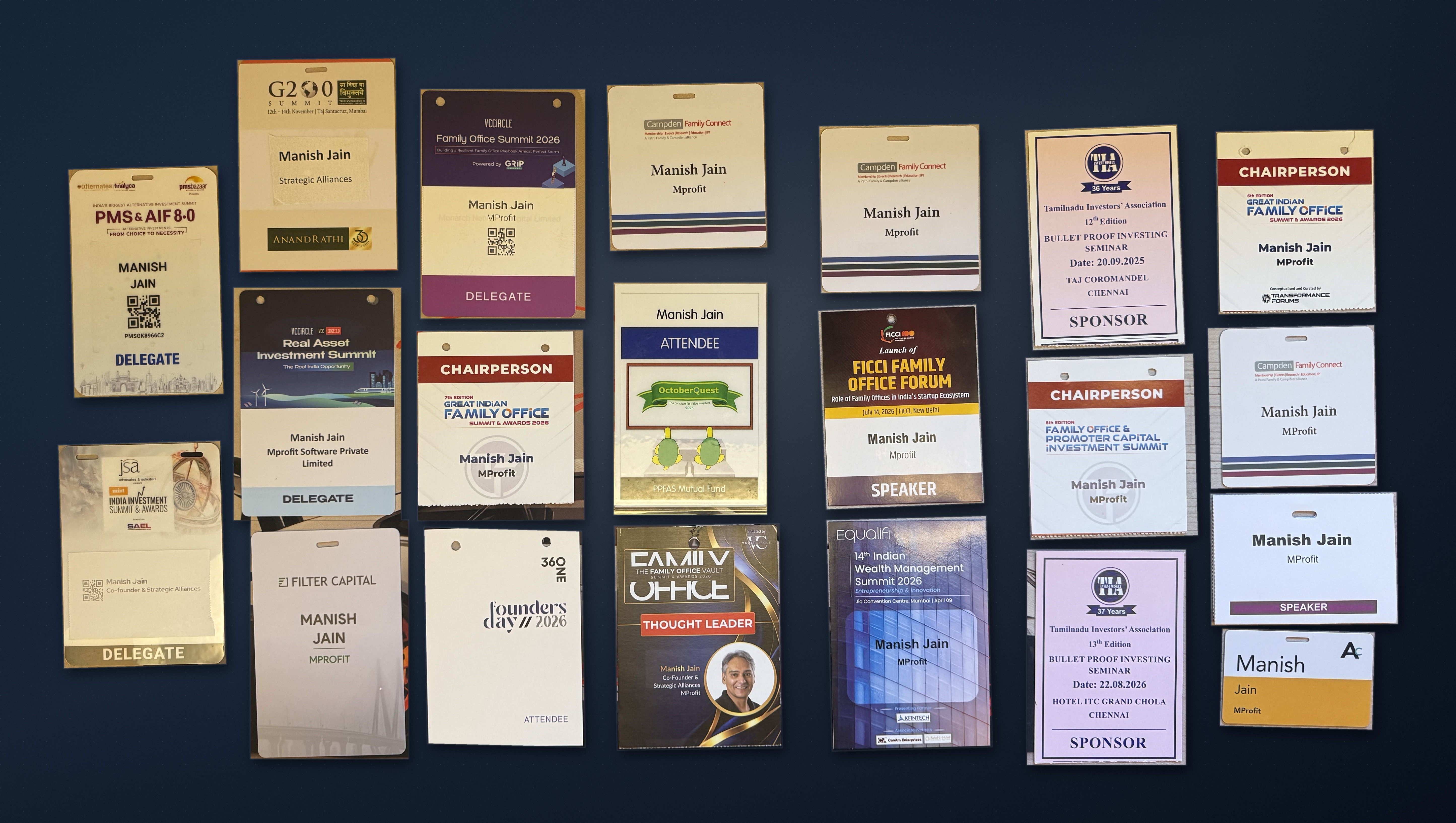
Over the past 18 months, MProfit has been part of more than 25 family office events across India. We have been invited to some, participated in and sponsored others, and simply attended the rest. Closed-door roundtables, panel discussions, intimate lunches, large-format forums. After enough of them, you start to notice an early indicator that predicts whether an event will be amazing, good, or merely okay.
First, know who you are actually inviting
Every event says it is for “family offices.” But a family office is not one audience. It is three.
- Principals: the family members who own the wealth, including the next generation.
- Trusted advisors: many families have that one person who has been with the family for 20+ years and is viewed as part of the family. They may hold an employee title, but they sit in a different category altogether.
- Employees: the CIO, CFO, analysts, the legal, tax and accounts specialists, and the operations and back office teams who run the machine day to day.
Each of these is a legitimate audience, and excellent events have been built for each. But they respond to completely different invitations. Once you decide who you are targeting, everything else follows, starting with who you invite. If your goal is to get members of the family in the room, the actual principals and next-generation members rather than their CIOs and analysts, the single biggest factor is not the agenda. It is not the speaker lineup. It is not even who else is attending, though that runs a close second.
It is location, location, location.
The airport hotel test
Here is the simplest version of the rule. In Bombay, if your event is at an airport hotel, the family is not coming. It does not matter how strong the content is. The invitation gets a polite response, and on the day, the principal sends someone from the team, or no one at all.
At first we assumed this was about convenience, and it partly is. For a family based in South Bombay or Worli, a trip to the airport belt and back can consume half a working day. Principals guard their time ferociously, and the mental math on an invitation happens in about five seconds.
But convenience is only half the story. The venue is a signal. When a principal reads an invite, they are scanning three things: who is hosting, who else will be there, and where it is. The address answers the third question instantly and quietly colors the other two. The right venue says this room will be worth my time. An offbeat venue says this one is for my team.
There is also familiarity and discretion. These are rooms the families already know. Their drivers know the location and the hotel staff know them. The private dining rooms have hosted a hundred conversations that never left the room. That comfort matters far more than most organizers realize.
The Bombay map
In Bombay, the list of venues that reliably draw principals is remarkably short: the Oberoi or Trident at Nariman Point, the Taj Mahal Palace in Colaba, the Four Seasons in Worli, and the St. Regis in Lower Parel. If you genuinely need a large-format space, the Jio World Convention Centre in BKC works. That is essentially the entire map. Notice the geography: Nariman Point and Colaba for old South Bombay, Worli and Lower Parel for the mid-town corridor, and BKC only when scale demands it. Everything else is a compromise, and your RSVP list will say so before you do.
We saw this firsthand in August, when we hosted our first event of our own: a private, off-the-record roundtable lunch for next-generation family members, held at the Four Seasons in Worli. No stage, no slides, no pitch. The venue had done half the work before a single word was spoken, and the people we hoped would be in the room were in the room.
It is not about luxury
To be clear, this is not about marble lobbies and chandeliers. The venue is part of the invitation itself. It tells the principal what kind of room this will be before a single speaker is announced. A brilliant agenda at the wrong address gets you delegates. The same agenda at the right address gets you decision-makers.
Everything else matters, second
Curation still matters. Format matters. Keeping sales pitches off the stage matters enormously. Those things decide whether people come back next year. But location decides whether they come at all.
None of this is criticism of the people organizing and building these events. The programming we have seen over these 18 months has been genuinely strong, and the Indian family office community is better for it. Consider it the one unlock that programming alone cannot deliver. So before finalizing the agenda or the speaker list, ask the question the family will ask first: where is it. Get that answer right, and everything you have built gets the room it deserves.


